Sunday, March 25, 2018

Assuring cats’ health: call it ‘guardian maintenance’!

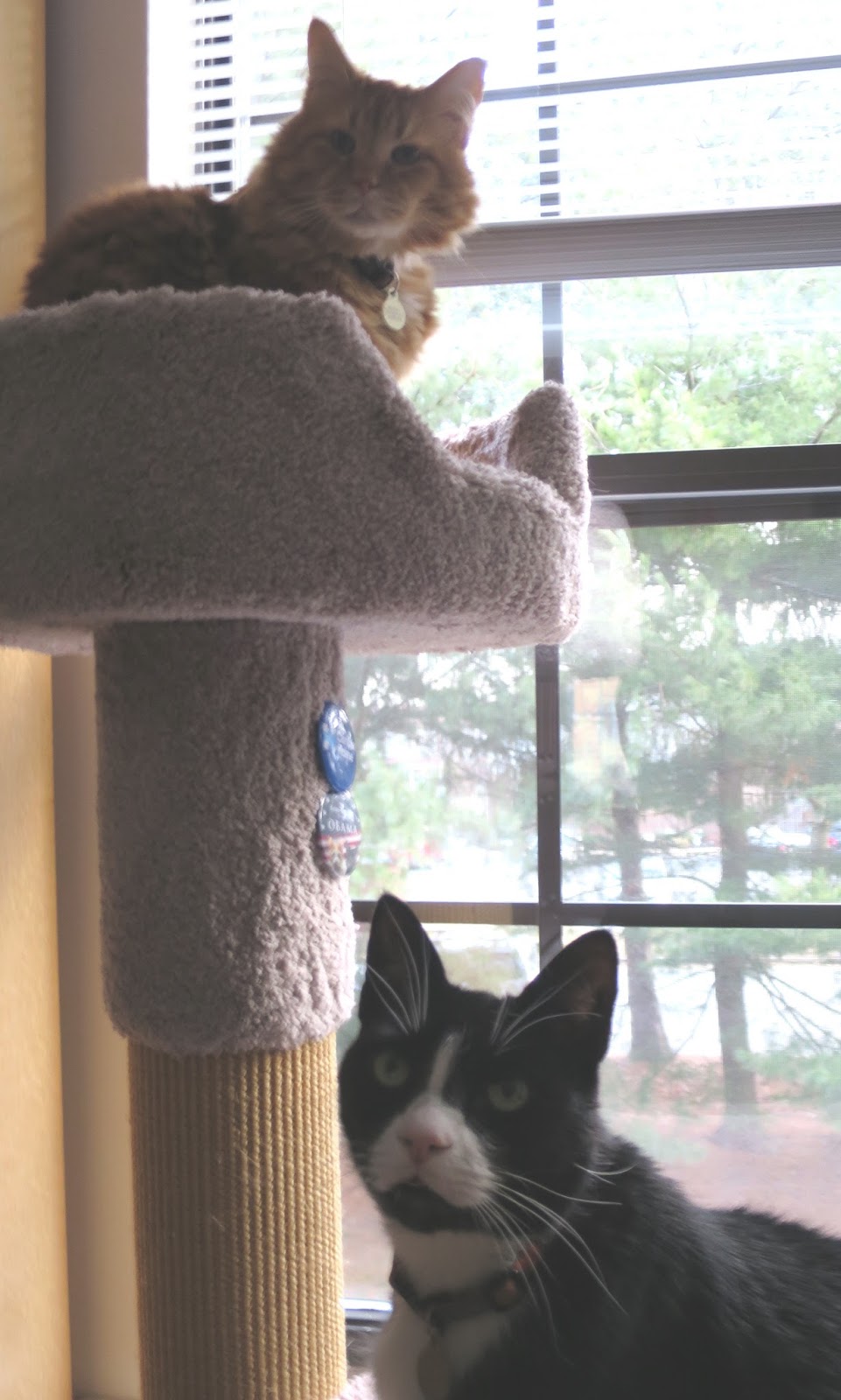
Harry (top) & Billy
Harry and Billy Summers are two very lucky cats, now flashing beautiful, healthy teeth.  It wasn’t cheap, or easy.  Nor was it the first or the last time their oral health was checked and assured.

This time around, their dental adventure cost more than $2,000 – a good deal less than the highest estimate the animal hospital had projected.  The total cost also included pre-anesthesia testing by their veterinarian and a 40-mile round trip to the specialist . . . then, hours later, a return trip for pick up, all after two postponements because of winter storms.

That expenditure of time and money (and emotion!) was just for their teeth, which I’ve been convinced must be kept healthy.

And there’s much more: “the Summers boys” also eat “vet food” – that is, prescription food to maintain a healthy weight (Billy) or care for kidneys (Harry).

And besides what amount to two annual check-ups for each boy, there are also periodic visits to eye and internal medicine specialists and the inevitable emergency vet trips – the tilted head signaling an ear problem; the upset stomach with projectile vomiting . . . and so on.

Don’t misunderstand: I’m not boasting or complaining.  I’m elated we can afford comprehensive health care for the two cats we dearly love. And I wholly trust both boys’ veterinarian, the dental specialist and others.

But. . . !

But: how many people can afford such thorough, or even basic, care for their cats?  I’m betting that many cats go without – which can mean shorter, less healthy lives.  

It’s sad to think how many pet cats don’t get even an annual check-up, let alone dental care.  Or beneficial food.  And of course, community cats – with shorter life spans by definition -- have it even harder.
http://www.catster.com/cat-health-care/increase-cat-life-expectancy

I have to wonder what happens for all the cats who are adopted out by rescue groups and shelters. Once those felines move into their “forever homes,” how do their well-meaning new families deal with the need for vet visits and, sometimes, heroic or major treatments?  Are prospective adopters told about the expenses involved with having a pet cat?

No doubt this situation is also true for pet dogs, for whom veterinarian care is pricey too – a fact probably equally true for other pets – ferrets, birds and so on.

What about medical insurance for pets, you may ask.  I’ve wondered about that.  The one time we had it, for a beloved cocker spaniel, a pre-existing health condition kept it from being useful.  After that, we gave up on insurance.  

There are ways to get help with medical costs for pets.  One example: the donation jar at the hospital where Harry and Billy had their teeth attended to – although I don’t know how common such jars are or how that money is allocated. 

Other options can be found on the website of the Animal Protection League of NJ (APLNJ), which lists organizations pet parents might try.  (Worth checking them out right now?)  http://aplnj.org/Vet-Bill.php

And too, why not ask the pet’s vet about special rates and payment plans?  (Who better to ask for help treating a pet than a vet, whose mission is caring for animals?)   

For now, with gratitude and relief, I’m crossing my fingers, knocking on wood and thanking the
power(s) that Harry and Billy are two very lucky cats.

#


If you subscribe to this blog and want to comment, please click here:  www.1moreonce.blogspot.com.  

Sunday, March 18, 2018

March Madness of a far different kind

Spring Peeper
“Almost spring” – the best reason to feel good about animals and the world and animals in the world (however briefly), with bird song in the morning again!  Can spring peepers be far behind?

By now, it’s all around: emergence (of green shoots and worms and black bears); growth (of everything, it seems); rebirth (of hope!). This year’s spring equinox arrives on Tuesday, March 20, at 12:15 pm, though the signs of its coming have already worked their magic. 

“Equinox” comes from Latin words that literally mean “equal night” because the length of day and night is nearly equal in all parts of the world.  Earlier dawns and later sunsets mean longer days with more sunlight hours – all to the good for those of us who suffer from SAD and other winter blues.
For “animal people,” the joys of spring also include the mixed blessing of “kitten season,” when these cunning baby animals can seem to be everywhere. Yes, they’re  adorable, and sometimes they are on their own, but remember to look carefully for mama cats before “rescuing” any babies. 

American Robin
Speaking of spring and birds and cats, it’s almost time to try the “cat fur good deed”: collect the fluff you brush from your shedding cats and sprinkle it outside.  I’ve read that birds – and I’d bet squirrels too – snatch it up to line their nests and warm their babies. It might even help prevent some young birds and squirrels from falling out of their nests.  Try it – they’ll like it!
 
Two recommended for readers

Moving away from nature's own March madness, here are 2 books to know about, thanks to a sympathetic librarian and blog-reading friend:

1 -- Clean Meat: How Growing Meat Without Animals Will Revolutionize Dinner and the World, by Paul Shapiro  (description excerpted from Kirkus Reviews)


An intriguing argument for developing an economy of cultured, lab-born meat because "clean meat" is already a reality. The first "cultured hamburger," produced in 2013 cost about $330,000; now it costs around $11 per burger. 

The same is true of animal foods and products of other kinds, from dairy to poultry to leather. Within a decade or two, it may be possible to eat meat that has not involved the suffering of a living animal and to wear shoes made of leather that has not come from a slaughterhouse.  

2 -- Mercy for Animals: One Man's Quest to Inspire Compassion and Improve the Lives of Farm Animals, by Nathan Runkle  (description from Amazon blurb)  

Runkle’s book tells how he founded this country’s leading nonprofit organization for protecting factory farmed animals. The work of “Mercy for Animals” has ranged from grassroots activism through undercover investigations to today’s efforts for sweeping legislative change.


Far-reaching negative consequences resulted when America moved from a network of small, local farms with more than 50 percent of Americans involved in agriculture, to a massive coast-to-coast industrial complex controlled by a mere 1 percent of our population.  But Runkle offers both hope and solutions for ending mistreatment of factory farmed animals, from diet modifications to directions for how to contact corporations and legislators efficiently.

These feet were made for . . .

Finally, how better to end a post on a joyful subject than to share this story about a happy ending for one spider – actually, as many happy endings as this spider has legs:

#

If you subscribe to this blog and want to comment, please click here:  www.1moreonce.blogspot.com.  


Sunday, March 11, 2018

Keeping chickens, cloning pets & shelter animals (still) in need


Raising chickens has become an “in” thing around the country.  Described as “a growing status symbol in Silicon Valley,” in a recent Washington Post story, “egg-laying chickens are now a trendy, eco-conscious humblebrag on par with driving a Tesla.” 
  
It’s also happening in New Jersey. After a two-year pilot program “to see if chickens and their neighbors could live in harmony,” the city council of Woodbury (Gloucester County) unanimously passed a law allowing “chickens to come home to roost” there. A $10 license fee allows residents to raise up to 12 egg-laying hens; no roosters allowed.

As one recently subjected to boring chicken tales and pictures from a distant relative, I’m neutral, at best, on this issue.  Especially since I assume most of those chicken-keepers are also chicken-eaters – though maybe not their own pricey fowl.

Chicken consumption is a whole other not-pretty story that we’ll get to later.  For now, suffice it to say that while the practice of equating chickens with cowards goes back centuries, with flimsy supporting reasons, today’s chickens – mass-produced in factory farms -- have never had a better reason to be cowards!  Who would want their lives, or deaths? 
   
Cloning pets: all wrong

Love your dog so much you can’t imagine your future without her?  Well, if you’re thoughtless and rich enough, you can have your dog cloned – once an idle wish among pet-lovers – as Barbra Streisand recently did.

Don’t think it was easy, or even a little bit fair to every non-human and human animal involved. Cloning takes a terrible toll, as the story below details.  Worst of all to me: it leaves homeless animals in shelters right where they are, while needlessly growing the pet population – and some of those creatures may also wind up homeless some day. 

Overall, a selfish and cruel “lose-lose.”

Animal shelter bill -- MIA

The “animal shelter bill” I’ve written about for more than three years, exclaiming over the good it would do for homeless animals “living” in New Jersey animal shelters: What happened to it?  Where is it in the legislative pipeline? When will it surface and be talked about and moved forward?

Work on this bill began years ago with a meeting of people who know and care about animal shelters and want to see them improved. They exchanged opinions and specifics for a couple hours on January 23, 2015.

Then came a long hiatus, when nothing seemed to happen – no meetings, no word, no action for shelter animals. 

Finally, a draft bill appeared, with feedback invited.  Then came another long hiatus, with no communication about bill status or how to support and move it.  Meanwhile, shelter animals languished and many died – unnecessarily, for sure, since so many animal shelters in New Jersey do their own ignorant, inconsistent and cruel things, pretty much with impunity.  

In fact, it was the horrors at the Helmetta shelter (shelter: such a misnomer!) that helped trigger that first and only meeting, filled with talk of a law to reform NJ shelters.  And yet today, some animals still endure filthy and unsafe shelter conditions, minimally trained staff with even less supervision, and seat-of-the-pants decisions and actions that can be lethal.  
   
What happened to the shelter-reform bill, initially numbered S3019 and now S725?  Where is it in the legislative pipeline?  When will it re-surface and be talked about and moved forward for action? 

#


If you subscribe to this blog and want to comment, please click here:  
www.1moreonce.blogspot.com.  


Sunday, March 4, 2018

1 winning website & 1 death-dealing practice

Frankie
Some time ago, I confessed to a weakness for The Dodo, the website with short, effective videos and stories, all starring animals.  For a go-to-sleep picker-upper, I recommended looking at The Dodo last thing before bed each night.

Now after a few years of Dodo-ing, and still liking it a lot, I’m even more aware of some of its regular messages, which I like and have learned from.  One of the threads through Dodo content is that pit bulls are nice dogs – at least as nice, and needy, as other dogs. So many stories about heroic pit bulls, hurt pit bulls, baby- and people-loving pit bulls, all needing only the chance to show their sterling qualities.

Another Dodo message has been that animals with what might be called “deformities” are really only “different,” or “special,” and utterly lovable in their own right – as well as loving in return. What a great thing to believe, and act on!

The latest example is Frankie, the kitten born with two pairs of ears – a new phenomenon to me – who was adopted by a “mom” who recognized his high spirits and "deservingness" to live. Before him, there were bait dogs, badly scarred in their past lives; abandoned animals, left to die because they weren’t traditionally attractive; animals born with various birth "defects" that only made them different, not undeserving of life!  

Still another worthy Dodo message has been about the friendships between different species of animals – cats and horses, dogs and squirrels, even cats and dogs.  From their stories, a big element of their successful bonding was that the people around them seemed to expect it, and fostered it.  None of that “Ohh, watch out, you know X and Y don’t get along!” stuff.

Lucas
There’s still more to be said about how The Dodo (www.thedodo.com) is good for animals, and I’m a continuing fan. For now, though, another kind of animal – a well-intentioned one -- in the spotlight: a spider.  And not just any spider, but an animated one, designed to help people like spiders (or at least respect their right to life), instead of squishing them.  Meet Lucas the jumping spider . . .  

Donating dilemma

The Olympics are over, but South Korea’s dog-meat farms continue.  There are thousands of them, and it will take much more than a few Olympians to change the culture of a country where people see dog meat as a delicacy and dog meat farms as the way to feed that appetite. 
https://www.thedodo.com/close-to-home/olympian-gus-kenworthy-saves-korean-dogs

And that leads to a donation dilemma for anyone wanting to contribute to better lives for animals: give to the organizations working to eliminate dog meat farms, which may be a century-long undertaking, or choose different beneficiaries where results are faster and more comprehensive?
It can seem like the proverbial drop in a bucket to donate to, say, Humane Society International (HSI) on behalf of those terrified caged dogs who know their end is coming.  But then, donating nothing toward their possible rescue seems callous and cruel.

                                        Gus Kenworthy image
The only other option I can think of is hoping that humane millionaires will seize on this issue and donate mega bucks to eliminate dog-meat farms.  Maybe for long-standing problems that require long-time solutions, organizations should reach out to people with deep pockets, instead of working with much less to encourage Korean farmers, one farm at a time, to grow mushrooms instead of dogs.  

What do you think, readers?

Now I can look at you in peace; I don't eat you any more. --Franz Kafka

#

If you subscribe to this blog and want to comment, please click here:  www.1moreonce.blogspot.com.  


Sunday, February 25, 2018

A meat-free new fave that’s great -- hot dog!


What off-limit foods do vegetarians miss most?  Till a week ago, I would have ticked off canned tuna and pepperoni as foods I’d like to be hypnotized into enjoying once more (yes, I know: peasant tastes).  Well, I haven’t found substitutes for them, and I’m not into tofu cooking, or eating, but a few days ago, I tasted something I’d really miss if I also gave it up on principle: vegetarian hot dogs.

 OMG!  

And to begin with, my trying “Field Roast Vegetarian Frankfurters” was thanks to a feature story in a cat magazine that ID’d a couple delicious meat-alternatives for vegetarians (and vegans).  My caring about animals and not eating meat – was it virtue rewarded, in the form of a grilled vegetarian hot dog?  I’ll take it.  Again and again.

Roaming around the Field Roast website, I learned that whole wheat flour seems to be the most “solid” ingredient of these 200-calorie links; that garlic and onion and appealing spices are included too; and that there are recipes for other uses far beyond what I enjoyed: a butterflied hot dog, sautéed in olive oil and slathered with yellow mustard, on a roll.  (Next time, I’ll embellish.)  

Simple to prepare and easy to love, this meal was in great contrast to my pasta adventures, veggie mashes or eggs-in-some-form meals. 
   
I was also gratified to find numerous other Field Roast products, from appetizers and entrees through sausages, roasts and loaves – including, as you’d expect, the “Field Burger,” with this version blessedly free of the ubiquitous black beans.  Another product was meatloaf (think: meatloaf sandwiches!) with brown gravy.  Its description includes this line: “We’ll spare you the just-like-mom-made references; simply cozy up and remember that Field Roast loves you.

Loving it right back, I’m eager to find the nearest store with Field Roast’s line of products and try more of them.

Please note: This has been an UN-solicited and UN-paid gastronomical announcement.  And while I’m delighted to have discovered Field Roast franks-plus, I hope only that I haven’t been singing to the choir with this post.

Still thinking about those ghastly South Korean dog meat farms, I wish Field Roast could expand its production site(s) from Seattle to Asia and train farmers there to raise vegetarian food ingredients. That would be about as far away as possible from their horrible present “occupation.”   

From Humane Society International’s latest appeal:  
Kaya only wants to do what comes naturally as a mother–to keep her newborn puppies safe and fed. But every day she struggles to provide those basic needsundernourished herself, tethered by a heavy chain around her neck. This is her life, their life together, on a dog meat farm in South Korea.

These are just some of the dogs suffering on this farm for the trade in their meat. And the cruelty lies within the shadow of the events happening just down the road at the Winter Games in Pyeongchang.

            Day in and day out, Kaya copes with fear, hunger and freezing temperatures, while doing the
            best she can for her helpless babies. The other dogs on this farm are shivering in the dark, 
            many of them trapped in dungeon-like cages so small they can barely turn around.


The animals of the world exist for their own reasons. 
They were not made for humans any more than
black people were made for whites or women for men. 
--Alice Walker, poet and novelist

#


If you subscribe to this blog and want to comment, please click here:  www.1moreonce.blogspot.com.  


Sunday, February 18, 2018

Ketchup or mustard with that dog meat sandwich?


                                                                          Paper Cutting
The Chinese, or Lunar, New Year that began last Friday is a major holiday celebrated around the world.  Characterized by one of the 12 animals of the Chinese zodiac – rat, ox, tiger, rabbit, dragon, snake, horse, lamb, monkey, rooster, dog and pig – this is the year of the dog. 

Since in Asian astrology, the zodiac animal for a person’s birth year is believed to determine personality traits, think dog:  loyal, dependable, sincere, faithful to family, friends and work, popular in social circles.

That may bode well for people born in a dog year – if not for dogs themselves.  In many parts of Asia, the expression “lucky dog” simply does not apply.  For instance, every year is a gruesome year of the dog in South Korea, where a dinner featuring dog meat can easily be had within walking distance of the Olympic Games, with all the related human positivism and camaraderie.

South Korea “boasts” thousands of “dog meat farms,” where, as in China too, dogs are bred and raised for slaughter.  Both their lives and their deaths are hideous, as illustrated by this excerpt from a Humane Society International (HSI) appeal to South Korean government leaders:   

I am deeply concerned about the millions of dogs caught up in South Korea’s brutal dog meat industry, and I respectfully urge you to take action to protect them.
South Korea is the only country in the world known to have established a large-scale intensive dog meat farming industry, in which more than 2.5 million dogs a year endure brutal lives and painful deaths for their meat - a delicacy food that fewer and fewer Koreans choose to eat.

The suffering of these dogs is undeniable. They are kept in small barren cages, without protection from the harsh elements or even a solid floor on which to stand.  Physical injury from self-mutilation or fighting are commonplace, and death from disease, hunger, or exposure is rife.

For those who survive the grim farm life, death by electrocution is painful and terrifying. . . .

                                          HSI image
HSI is just one organization combating South Korea’s dog meat farms by offering other options to farmers and rescuing dogs. This week I learned about a laudable Olympic athlete who has joined the fight, speaking up against the practice and bringing saved dogs home with her. 

To me, Duhamel deserves more praise for her humane actions than for her athletic prowess.  She wants to keep the spotlight on South Korea’s abuse of dogs and cats (who are barely ever mentioned in stories about this infamous practice) long after the Olympics end.  I hope her advocacy wins support for as long as it takes to ban the dog meat trade in South Korea.   

 California cat haven-heaven

Even though I’ve blogged before about this wonderful woman and her home for cats, seeing a story about Cat House on the Kings (a river) in The Dodo was irresistible.  So here we go again.  I told a friend that if a travel company offered a trip – or would it be a pilgrimage? -- to this Cat House, it would be very hard to resist.  But would I ever come back?   

Oral health affects other health

                                                                          Catster image
A last word on feline dental care: Just knowing about the three diseases described in this Catster article might suffice to motivate making a vet appointment.  Scary as their names are -- periodontal disease, stomatitis and tooth resorption – ignoring them is even worse for your cat(s).  Please book now!

#

If you subscribe to this blog and want to comment, please click here:  www.1moreonce.blogspot.com.  


Sunday, February 11, 2018

Definitely ‘an idea whose time has come’!

                                                                            Catster image
You’ve heard of ambulance-chasers (business-seeking lawyers in the wake emergency vehicles) -- but how about mobile vet-chasers (help-seeking parents of pets)?  Disclosure: I’m one of them, and proud of it.

Not long ago, a van advertising “mobile veterinary service” drove down my street and I followed it till it stopped outside a home, where I engaged the driver in Q & As, and got a business card. 

It was all very appealing.  And about time.

How often have you wished you didn’t have to pack up your pet(s) to go to a vet?  Or, maybe a pet was too ill to travel, or you dreaded the wait and/or other sick pets at the vet’s?  If only the vet-pet connection were a two-way street, with vets who could travel to pets, as well as the other way ’round.

Not so long ago, the notion of vets making house calls was just a dream.  Now it’s a reality – as this Catster story reminded me.  Huzzah!

“Comfortable for pet and owner,” is how vet house calls are described by one area vet who should know: Jennifer L. Collins, DVM.  Her business, “Home Pet Mobile Veterinary Services,” has operated out of Robbinsville, NJ, for about a year.  Before that, Collins worked at different practices for a couple decades and currently fills in for staff vets at West Trenton Animal Hospital. 

                                                                           Collins image
Now, with her “clinic on wheels,” she’s a one-woman show – a boon to pet parents who may be older, disabled and/or don’t drive.  Big pets who are hard to get into vehicles and others who don’t travel well are also served by a mobile vet like Collins.

Offering “comprehensive veterinary care for your dog and cat in the comfort of your home” and “serving Mercer County and surrounding areas,”  Collins does exams, lab work, spays and neuters, dental care. . . .  Although her website’s under repair, she can be reached via phone (609-775-1230) and email (HomePetMobileVet@gmail.com).    

As for the mobile vet vehicle I followed? That was HousePaws Mobile Veterinary Service (www.HousePawsMobileVet.com), at 856-234-5230.  

How about you, readers: Any mobile vet services you’d like to tell us about?  I hope you’ll  comment – it’s easy.  (And please revisit the terrific comment on this subject at the end of my January 1 post.)  

A few briefs  

 Billy says "a-h-h-h-h-h!"
It’s a mouthful to say (so apropos!), but it’s way important: February is “National Pet Dental Health Month,” and that means book a date for your pets to have their smiles checked out – so they can keep smiling.  Since we started out here with Catster info, let’s continue with two good articles about cats’ teeth. One’s a useful overview -- 

-- while the other deals with the importance of teeth cleaning.   

We’re not through with emotional-support animals on airplanes.  Soon after my post on the subject, Dexter the peacock -- you read it right -- was denied a ride.

In reaction, a suspicious columnist said basically “enough, already!”  

Did anyone else wonder what became of Dexter?  Did his human board the flight anyway?  Who took Dexter home, and how?  

And finally, next Friday, Feb. 16, marks the Chinese, or Lunar, New Year.  Best wishes for the year of the dog!

#


If you subscribe to this blog and want to comment, please click here:  www.1moreonce.blogspot.com.