Wednesday, June 29, 2022

Kitty, don’t roam -- please stay at home!

Heartbreaking things happen: for instance, a cat can get lost or just plain disappear.  Then: what to do?
Lily

How can the cat’s person – always loving but now also distraught -- find the missing feline?  It’s an unhappy situation to be in.

Knowing where the cat was last seen would help.  No need to search the neighborhood if it’s certain no doors or windows were opened since the cat was last spotted in the kitchen.  S/he’s somewhere in the home – and that’s challenge enough!

If there’s general uncertainty about where the cat was last seen, and equal uncertainty about the feline’s favorite haunts both inside and outside the house, that presents a bigger problem and may require a wider search.  The pet’s family can choose from among multiple approaches to take.

First, let’s hope the cat was microchipped on arrival (with the number noted and saved), and second, that good cat photos are on hand.  If Y on both, that will make “Lost” signs and contacts with shelters and rescue groups much easier.  (A cat collar with breakaway clasp is a good addition.)

If the cat was trained to “come” on command (with treats as obedience rewards), that could be invaluable in case s/he’s somewhere in the home and able to hear voices calling her.  With luck, she’ll respond, reappear and be welcomed back.  

If a pet parent doesn’t have a plan for finding the cat before he goes AWOL, here are some possible steps for both inside and outside. 

In the home (which can include basement, garage and any shed-like buildings), check seemingly very small and inaccessible spaces that cats are marvels at getting into.  Same with closed rooms and closets where a cat may have been exploring when the door was closed without knowledge she was there.

That goes for places in the garage and any vehicle, where cats seeking warmth sometimes settle in, out of sight. 

An outdoor search opens things up considerably. It’s common knowledge that  missing cats are often found close to home, hiding quietly when scared or injured and often not meowing when called.

Two things to do outside the home: set up a humane trap (possibly borrowed from an area shelter or rescue group) and keep watch so if the cat ‘bites,” s/he won’t have to be there long.  Also, leave a bowl of food outside, to attract that errant feline.

Loki
Search categories outdoors can include in-person action: post signs with the feline’s picture, use door hangers, knock on doors to alert neighbors, notify area rescue groups, visit local shelters in person (remember: cats usually don’t last long in shelters before being euthanized), inform workers in the neighborhood (landscapers and mail carriers are in positions to notice animals on the move).

Social media offers myriad ways to spread the word about a missing cat: Facebook, of course, including some communities with lost pet pages there, and Nextdoor, a free network for neighborhoods that offers a lost pet post and the pet directory.  Helping Lost Pets.com is another online means of searching.

From Catster magazine and Catster.com, check out (1) 13 tips on how to find a lost cat; (2) The search for Phoebe: Tips to find a missing cat and (3) 8 ways to keep your cat from escaping outside this summer.

Other places to look for a missing cat or get ideas for how to look include Mission Reunite.org/find a lost cat; PetFBI.org; and MissingAnimalResponse.com.

Then there’s always the case of the cat who decides to go home – back to his last home, that is.  Pray for that feline.

To start considering all these possibilities only after a cat disappears could impede success.  The best approach is to have a plan ahead of time so you can move quickly as soon as the cat’s clearly “outta here.”  

An even better idea is simply making any family cat “indoor only,” for everyone’s sake.

#


Please help improve this post: tell us about other/better ways you used to find a missing cat and what methods here sound good – or not.  You can comment at 1moreonce.blogspot.com.


Sunday, June 19, 2022

Vilified dog breeds, beautiful chickens & shelter cats


Doberman pinschers, Chow Chows, Rottweilers, pit bulls, mastiffs, German shepherds: what comes to your mind when you see this list of dog breeds?

Probably not “cuddlesome,” “lap dogs” or anything like that.   

Mystique
Those breeds are the ones people may be apprehensive about or even assume are dangerous – and the ones that traditionally make their jobs harder for insurance company employees.
  Why?  Because they often charge extra or deny policies to homeowners or renters whose pets fall into those breed categories.

But, thanks to a New York law that took effect in January, our neighboring state has joined 3 others (Pennsylvania, Nevada, Michigan) in requiring “breed-blind” insurance.  And that brought joy to those who have long fought for such legislation, which ignores unfair assumptions about specified breeds.

A big, sad problem in states where assumptions about some breeds keep their owners from getting insurance policies is that too many dogs must then live in shelters instead of loving homes.  Understandably, people shy away from having big, thought-to-be dangerous dogs without insurance.  

More and more, though, dog advocates argue that canine behavior is based on how they’re raised, not their breed.  That sounds reasonable, doesn’t it?  All of us probably know at least one perfectly nice pit bull or Rottweiler, and maybe that surprised us at first.  

Rosie
A common argument against certain breeds is that most people are hurt or killed by pit bulls.  Problem is, even if that breed’s numbers are highest, the data are too often anecdotal or biased.  Further, numbers don’t tell the whole story: did the dog act on impulse, was the dog provoked, mistreated or protecting its owner?  The full story can make a big difference, despite the totals.    https://tinyurl.com/26ezyh8

Years ago now, many of the dogs freed from football player-turned fight-dog owner Michael Vick were rehabilitated and adopted out to families all over.  Those dogs were among the first to prove such animals could recover from the horrible lives and training they had experienced.  (Until then, freed fight dogs didn’t get second chances.)

The study mentioned here on May 29 confirmed that breed doesn’t necessarily predict a dog’s behavior.  And The Dodo has reinforced all that: https://tinyurl.com/2p9y4jrv  

 Chickens’ glorious past

Although the history of chickens is debatable, it’s known they started out as colorful, exotic birds of the jungle.  Their long transition may have started in Thailand, where the development of rice and millet could have lured them out of the jungle.

Fossils suggest that after they reached Africa, it could have taken chickens “a full millennium to reach Scandinavia and Scotland.”
 Even after spreading all over Europe, chickens still weren’t eaten -- to begin with.  They were treated with reverence long before they were seen as edible.  

At that point, “poultry husbandry" began.  https://tinyurl.com/3samakjw

Bring a shelter cat home

 Hurry up!  June is “adopt a shelter cat month,” according to People for the Ethical Treatment of Animals, or Peta.  (“Animals are not ours to experiment on, eat, wear, use for entertainment, or abuse in any other way.”)

Bernie
And right now, with “kitten season” underway, shelters are fast filling up with winsome fluff balls who are hard to resist.  But shelters also house cats of all ages -- teens, adults and senior cats – and felines in those categories are often overlooked while irresistible kittens flood the market.

Which is why, since cute and cuddly kittens inevitably grow into teens, adults and seniors, it’s a great – and generous – idea to visit a shelter and choose a grown-up cat to adopt.  Often “the older the better” is better, and senior cats deserve to spend their “later-in-life years” in a home, not a facility.

Right now, decide which shelter you’ll visit first!   

#


Go to 1moreonce.blogspot.com to comment.


Saturday, June 11, 2022

Greenish tigers, 'lost' animals & adaptable deer

Nimmo
“Tyger Tyger, burning bright,/In the forests of the night . . .”  Yes, as poet William Blake knew, tigers are big, beautiful cats.  And in their natural habitat, they are fierce hunters. 

But doesn’t their vivid striped orange beauty make them conspicuous to prey animals, who might see them “burning bright” in time to get away?  There’s a good reason for why tigers don’t miss too may meals (explained and illustrated in the March ’22 newsletter from the Performing Animal Welfare Society [PAWS]).

Tigers’ prey animals see them very differently from how we do.  Humans and many other animals (including great apes and marsupials) have “trichromatic” color vision, so we and they can see blue, green and red, and those three colors in combinations.

However, most mammals – including tigers and their prey – have “dichromatic” vision that lets them see only two colors, blue and green.  So prey animals see tigers’ orange coloring as shades of green in the forest, making tigers well camouflaged and harder to detect.

Dinner is served.       https://tinyurl.com/54zztave

Watch your words!

Our word choices can help determine whether a dog or cat outside alone with no owner around will be taken to an animal shelter or reunited with her owner.  That’s because “lost” and “stray” can suggest different meanings to people.

When people think of an animal as being “lost,” they’re more likely to assume he lives locally and take steps to help find his home than to take him to a shelter.  But when an animal’s described as “stray,” people are less likely to work at re-unifiying her with her owner, and take her to an animal shelter instead.

The problem is that for many reasons, once in a shelter an animal has little chance of being reunified with his owner.  And that’s a real shame because the great majority of animals brought to shelters are lost -- they belong to somebody.   

Still another good reason for reunifying lost animals with owners: that’s the #1 way to reduce animal

shelter populations.     https://tinyurl.com/y4r2nbjp

Oh, my deer

Lately, it seems, deer have become a popular discussion and argument topic for a wide variety of people – from activists who want to protect them, through environmentalists who rue the plant life that deer destroy, to hunters, who want license to kill them wherever and whenever possible.  

Since last November, I’ve held onto a New Yorker magazine article studded with surprising info about deer and how people have regarded them so differently over time – capitalizing on them, sterilizing and hunting them, protecting them.  One key sentence sums it all up pretty well: 

Many of our ideas about animals – which we eat, which we keep as pets, which we vilify or protect – are changeable with time and context and culture.     

Opening with a narrative about a 2016 deer-sterilization project on Staten Island, the writer moves on to other issues involving both deer and human inconsistency toward them.  One big surprise for me was learning about synanthropes: “a tiny minority of wild animals – not livestock or pets – that have adapted to thrive in the places that humans like and are forever building more of.”  These include city pigeons, rats, coyotes, Canada geese . . . and deer.   

“Today,” the author says, “there are an estimated thirty million white-tailed deer in the U.S., a hundred times more than there were in 1900.”     

 https://tinyurl.com/49j49cje

#


You're invited to comment at 1moreonce.blogspot.com.


Sunday, May 29, 2022

Doggone mistakes about dogs’ behavior & water skills

True or false: You’re heading to the beach and decide to take your new dog swimming too.  No worries: dogs can swim.

True or false: You avoid getting too near that pit bull in the park with his people – those dogs are vicious.

Both statements are false, as are many other assumptions about various dog breeds.  Pit bulls can be needy cuddle pups, and not every dog automatically knows how to swim (or even like the water).    

A couple recent media stories about dogs have featured some startling canine news.

First, according to one study, “Don’t judge a dog by its breed.”  (Are you reading this, people who bar renters with pit bulls?)  The findings indicate that “on average, a dog’s breed only accounts for about 9% of the variations in any given dog’s behavior.” 

Mystique
That result alone is surprising and casts doubt on breed stereotypes of aggressive dogs like pit bulls, who, BTW, scored high on human sociability!  

Yes, dog behaviors are strongly inherited, but, “the genes that shape whether your dog is friendly, aggressive or aloof date from long before the 19th century.”  Most recent dog breeding has been mainly for physical characteristics -- a practice that led to various discomforts and deformities that dogs now must endure.      https://tinyurl.com/2p8acvb8

Doggie paddlers

Q: Can all dogs swim?  A: No!


While some dogs are bred for the water (think: Labs and Portuguese water dogs), others have body types that make swimming hard for them (think: bulldogs and dachshunds).

These facts lead to tips for getting dogs used to water and teaching them to swim.  Possibly the most important tip of all: show your dog how to get out of a pool or body of water via the entrance ramp or the beach. 

Further, for any dog commonly around water – near a pool or in a boat --  a doggy life jacket with handles will help ensure safety and a spray sunscreen will protect the animal from sunburn.  (And get a load of the dog swim vests, life jackets and other floatation devices available for dogs.  One, patterned like the US flag, resembles a long mailbox when worn.)    https://tinyurl.com/5n6zwy47

An exotic, aromatic pet?

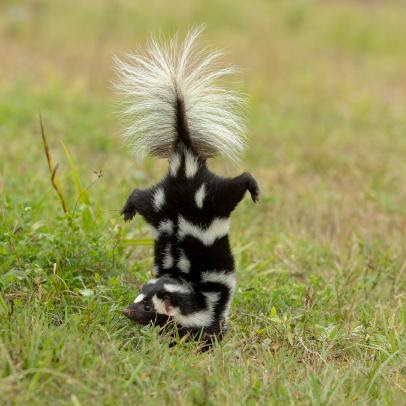
Some of us have clucked over images of baby groundhogs (“Awwwww”!), but can we resist pictures of spotted skunks?  Not only pretty, they can also do spread-eagled handstands . . .before spraying us. Now, that’s a picture!


Unlike everyday striped skunks, the spotted ones are smaller and decorated with white blots -- but they still pack “a fanny full of foul-smelling liquid” they know how to use.

It’s recently been determined that there are actually seven species of spotted skunks, half found in the east and half in the west – with some overlapping – while the seventh is native to Mexico’s Yucatan Peninsula.

One scientist who studies these “malodorous mammals” says it’s possible to sneak up on a spotted skunk and not get sprayed, while admitting that “skunks are like people. Some of them are just jerks.” 

So much for the “pet” idea.    https://tinyurl.com/22d3hsuh

Pigs don’t have a prayer           

Greeting card seen in local store with an image of browned bacon strips on the front: “I like you more than bacon.”  Then inside: “That’s the highest compliment. . .”  

Not long ago, it was a pig’s heart in a man, prompting talk of breeding pigs for that purpose, and now this bacon-obsessed mentality about love.   

Enough!

#


To comment, go to 1moreonce.blogspot.com


Sunday, May 15, 2022

Of Canada geese & 'traditional Chinese medicine'

To some of us, Canada geese are the creatures who litter sidewalks with their excrement, causing pedestrians to hop-scotch forward while cursing the birds.  To others, they nest in inappropriate places, such as near the entrance to a business building surrounded by (inviting) green lawn.

In short, the Canada goose is sometimes regarded as the persona non grata of the wild bird world.  Those who know little if anything good about the birds opt to have them gassed or otherwise disposed of – as if that were the only way to solve the problem that sometimes exists.

But it doesn’t have to be that way, as the Animal Protection League of New Jersey (APLNJ) keeps proving.  Through its Canada Goose Protection Program, APL members talk up and demonstrate humane, non-lethal ways to coexist with Canada geese and deter them from being in places where they’re not appropriate or wanted. 

Nesting Canada goose
When that happens, communities have no need to  contract with the USDA or other exterminators, and people’s view of the birds becomes much more accepting. 

And why not, since Canada geese can boast of many sterling qualities, according to those who know them well: They mate for life. They’re both highly intelligent and protective, loving parents who teach their children to survive and co-exist with humans, who could learn from them!    

Here’s an overview of what APLNJ is doing around the state to protect Canada geese by stopping goose gassing and presenting real alternative actions that make it possible for people and geese to live together.    https://conta.cc/37QQTyO

This is the season when goose gassing begins, so right now is the time to be aware of the options for dealing with Canada geese – needless killing or humane, non-lethal alternatives.

Infamous ‘medicine’

Pangolin
For how long have we been familiar with the phrase “traditional Chinese medicine” (TCM) then, based on that last word’s assumed credibility, never gave it another thought?  I'll bet we didn’t know what those 3 words were all about . . . until we kept seeing them connected with poaching and killing of animals so their body parts could be used in that so-called “medicine.” 

That’s right: “TCM” traditionally uses animals for something described this way by Wikipedia: “An alternative medical practice drawn from traditional medicine in China.  It has been described as "fraught with pseudoscience", and the majority of its treatments as having no logical mechanism of action.”  https://en.wikipedia.org/wiki/Traditional_Chinese_medicine

For that, innumerable animals have died and will continue to die?! 

The "need" for these animal parts has driven some species closer to extinction and of course has engendered and encouraged poachers (sometimes described as "the most hated creatures in Africa"), who hunt restricted or endangered species to fuel TMC.

Just a few “for instances”: pangolin scales, tiger bones, rhino horns, seahorses and bear bile are used in “medicinal” compounds as part of TCM.  And please note: thousands of Asiatic black bears are held in bear farms for the severely painful ongoing process of accessing bear bile, which is also an ingredient in an injection recommended for treating Covid-19.  (Would you take it?)

https://www.nationalgeographic.com/animals/article/siberian-tigers-are-being-hunted-at-night-for-their-body-parts?loggedin=true

Stingray
Animal parts sought for use in TCM include stingray gill plates, testicles and penis bone of dog, shark fins and lately, donkeys (now endangered and removed from some African countries, where they’re truly needed by laborers, for this “pseudo-scientific” purpose.) 

This continued poaching and killing of animals for “traditional Chinese medicine” is reminiscent of  Canada's annual seal slaughter, when it’s claimed that clubbing baby seals for their fur is also part of a long tradition and therefore should continue.

But in criticizing “traditional Chinese medicine” and other questionable traditions fatal for animals, remember that this year in the US, a pig’s heart was implanted in a human, and talk immediately began about how easily pigs could be bred, then killed, for this purpose. 

What a world.

Asiatic Black Bear


 #

 Please comment at 1moreonce.blogspot.com


Saturday, April 30, 2022

Enough great cats for everyone who'd love to have one

Wolfgang
“Wolfgang, the cat I've been working so hard with -- he made biscuits for me for the first time today!  They were tiny biscuits, but biscuits none the less!”  

 Andreya Dunks, an assistant manager at the Ewing Township Animal Shelter, exclaimed over a breakthrough with one of the cats. 

Her caring enthusiasm is so typical of the cat-positive attitude found there that you might want either to be a resident cat. . . or to adopt (at least) one! 

As animal shelters go, this one, managed by the EASEL Animal Rescue League, is packed with desirable elements: it’s proudly a no-kill facility; it’s populated with cats who generally seem contented as they wait for adopters to choose them; it’s relatively spacious, with high, wide cages and windows – a real boon; it’s a happening place, with lively people in and out and “roamers,” or cats allowed the run of the cat room.

Snookie
And for many good reasons, the Ewing shelter does a boom business in cat adoptions.  Meet a feline you like one day, and there’s a good chance s/he won’t be there if you wait too long to come back and renew your acquaintance.  “Now you see them, now you don’t.”

Why is that?  Because complete information about each cat is readily available and an effective adoption team works on their behalf.  For instance, newly arrived cats are carefully checked out while temporarily housed in the trailer outside the building.  Each cage has a color-coded sticker showing the cat’s strengths and needs – for instance, a green circle denotes a happy cat, while a yellow one means go slow; skittish feline.

Extensively trained volunteers then work with each one toward becoming adoption-ready.  As space permits, those cats move into the building, where they can be visited by would-be adopters who have successfully applied to adopt.

Jasper
Still other felines are also housed in the cat room at the local PetSmart, a successful meeting, greeting and adopting place, while special needs cats – elderly and pregnant cats, kittens for bottle feeding and those having difficulty in the shelter – are among those going to fosters.   

Shelter rules are designed to benefit the cats.  For instance, bonded pairs of felines are not broken up; it’s a two-fer or a no-fer.  As with people, cats can also have health conditions that can’t be ignored.  An example: those who are FIV+ can go home with adopters who understand they’re safe and can lead normal lives.

All cats need medical clearance before moving to loving homes.  O’Reilly had a worrisome bump on his nose, so only when a vet declared it benign and removable could he leave the shelter.  Warren’s adopter happily agreed on canned food for this handsome old orange cat because most of his teeth had been removed.  Caramel Apple’s hyperthyroidism is treatable with two daily meds – a responsibility her adopter willingly accepted. 

Zane
So, what’s in a name when it belongs to a shelter cat?  For one thing, a name can invite a possible adopter to take a closer look.  (Wouldn’t you too, with felines named Lucius and Malfoy, straight out of Harry Potter?)  Those two beauties were snapped up by adopters who definitely don’t live in Slytherin House.  

The website – easelnj.org/cats – is attractive and informative, an ideal way to get both an overview and details on how things work at the Ewing Township Animal Shelter.  

“Oh!  As I walked by today, Wolfgang came to the front of his cage, purring, without my even having treats or opening the door!  He was just asking for attention (that I of course gave him!).  I never thought he would                                       get to this point!  (Hoping he's adopted soon!)” 


Cormac


(The Ewing Twp. Animal Shelter is at 4 Jake Garzio Drive (in the municipal complex), Ewing, NJ.  Phone 609-883-0540  Website: easelnj.org/cats.  Note: Not all the cats pictured here are still available for adoption!)

 # 


Cat comments are welcome at 1moreonce.blogspot.com

Thursday, April 14, 2022

News briefs on animals: cats’ knees to magpies’ smarts

Because my list of animal topics for this blog grows longer every day, I’ve decided this is a good time to share some of them here.  I’ve written a brief overview of each one that especially appealed, ending with a link to the source.

Then you can take your pick and start reading!  I hope you’re as fascinated by each story as I was.  

Manatees' salad:  Earlier this year, Florida manatees were starving because sea grass, their main source of food, had been mostly wiped out through human actions.  So, in an unusual move, lettuce by the ton was provided to the hungry mammals.  Enough?  We don’t know yet.

 Even if the lettuce suffices, the manatees will still be up against the same culprit: humans.  First, it was fatal boat strikes; now it’s pollution that destroys their food supply.  Much as people claim to love manatees, will they ever care for them enough to stop killing them?  https://tinyurl.com/mrx7mfpb

The knees know:  Do cats have knees?  That’s the last question you may have thought to ask about your beloved cat while admiring her feline grace in movement.  Have you ever heard anyone refer to this body part in cats? 

Annie
Fact is, cats do have joints that function the same as knees and elbows — they just aren’t called knees and elbows . . . and your cat’s knees might not be where you think they are. 

Now that you’ve started wondering about this, take a look at the illustrated story below.  And while you’re at it, try to not even think about bees’ knees.  https://tinyurl.com/3zky2wsw

Cats & arthritis:  Speaking of knees and joints and thinking of cats’ lithe moves, they do grow older and can suffer from arthritis, causing pain that cramps their style.  Which is why news of the first cat arthritis drug OK’d by the FDA was announced with such fanfare earlier this year.

Look into Solensia, an injectable medication given by a veterinarian once a month to help control osteoarthritis pain in cats.

Hippos endangered:  Massive and frightening as hippos are – or maybe for that very reason – hippos and their body parts (like teeth, skin, skulls) are widely sought after by traders and trophy hunters.

Regarded as “ecosystem engineers” in the African river and lake areas where they live, hippos are a captivating sight moving through water channels, reinforcing routes. 

                                                                               Hippo Advocacy pic
But now, slaughtered in cruel numbers, hippos must be protected.  To save them from near extinction, we should ask the US Fish & Wildlife Service to list them under the Endangered Species Act, assuring federal protection from such obscene results as a glass-topped table resting on a hippo skull.  Sick.   https://tinyurl.com/ypkkybcd

‘Smooshed’ look is out:  You know what they say about dogs being our best friends.  That’s nice, but humans are far from best friends with Bulldogs and Cavalier King Charles Spaniels.  So dramatically have we inbred them into smooshed-faced pets that too often, they have short, difficult and unhealthy lives. 

The good news is that a court in Norway recently ordered a stop to breeding these dogs.  Viva, Norway! – but where is our AKC on this issue?  (The answer to that is bound to be long and UNsatisfying.)

https://tinyurl.com/5cp7mupa

Magpies: beauty & brains:  More and more, birds are seen as much more intelligent than thought till recently.  The Australian magpie has been called “one of the cleverest birds on earth,” with proof that goes far beyond its ability to remember up to 30 human faces and produce “beautiful songs of extraordinary complexity.”

Magpies’ latest feat was to outsmart scientists who had carefully made tracking harnesses for them.  Instead of cooperating, the birds helped each other remove the harnesses (birds: 1; scientists: 0; end of study?).   https://tinyurl.com/2szkxzrt

New way to help:  And finally, although first in importance, Humane Society International has initiated a new way to help Eastern European animals  (including those who escaped from Ukraine).  If you still want to help these needy animals, or to help them again, please look here then take action:  

https://www.hsi.org/news-media/free-veterinary-care-for-pets-of-ukrainian-refugees/ 


     Please make time to dip into these animal news briefs during your spring holiday weekend!    

 #                    


                                  To comment, please go to 1moreonce.blogspot.com.