Sunday, July 24, 2022

A historic beagle rescue, a big cat bill & tales of whales

“Government inspectors found that beagles at the facility were being killed instead of receiving veterinary treatment for easily treated conditions; nursing mother beagles were denied food; the food that they did receive contained maggots, mold and feces; and over an eight-week period, 25 beagle puppies died from cold exposure. Some dogs suffered from injuries when they were attacked by other dogs in overcrowded conditions.” -- HSUS

I have always heard good things about beagles’ temperament, which has made them popular, easy-to-work-with lab animals.  How supremely unlucky for beagles. 

During the last week, a rescue began for some 4,000 beagles in a facility where they were bred to become lab animals.  The Humane Society of the United States (HSUS) is leading the rescue, which also involves other animal-advocacy organizations, to move the beagles into shelter-partner sites around the country for eventual adoption. 

This move, with its great humane motivation, is thrilling to know of.  I hope people all over are following the HSUS news, watching for specifics on where the beagles are going, donating to HSUS to help the effort and thinking very seriously about adopting!       

https://www.humanesociety.org/4000beagles

https://www.youtube.com/watch?v=AZo_j-U_J-0

For both big cats & people

A federal bill that would curb or end the exploitation and suffering of captive big cats and protect the US public – the Big Cat Public Safety Act (H.R. 263) – is coming up for a vote this week.  Please contact your US representative to urge a positive vote on this important legislation.  

Basically, the bill aims to (1) prohibit the possession by private individuals of lions, tigers, leopards, cheetahs, jaguars, cougars or any hybrid of these species, and (2) restrict direct contact between the public and big cats of any age.   

The Performing Animal Welfare Society (PAWS), one organization urging passage of this bill, points out that since 1990, there have been nearly 380 dangerous incidences involving captive big cats in 46 states and the District of Columbia, with 25 people killed and many more injured.

What else does it take?

It also takes this: “Cub petting operations continuously breed big cats so they can sell photo and handling sessions with young cubs to the public.”  After being “torn from their mothers shortly after birth,” the cubs are exploited and often mistreated.

Once they grow too big to handle or bring in profits, cubs may be “funneled into the exotic pet trade, sold to other disreputable exhibitors, or ending up in the illegal trade in wildlife parts.”

This is all very ugly. 

To repeat: Please ask your US rep to vote "yes" on the Big Cat Public Safety Act (H.R. 263).  Thank you! 

Huge, invaluable & jeopardized

Whales, cetaceans, leviathans . . . just a few ways to allude to “fully aquatic, open-ocean” marine mammals, including the blue whale, “the largest animal known to have ever existed,” according to Wikipedia.  And not only the largest, but also intelligent beyond belief, incredibly feeling and, alas, long victimized by humans – to the extent that some are already functionally extinct, while others are “endangered.”

A comprehensive description of whales and whale history that will amaze and (properly) depress those who listen to it can be found in “Whale Nation,” a two-CD set.  The first CD is devoted to Heathcote Williams’s extended poem about these majestic creatures, while the second CD, about whale history, is read by Williams, Harry Burton and Caroline Webster (beautiful, stirring voices all). 

For those who care about our world’s threatened environment and its animals, I recommend buying or at least listening to this impassioned CD.


 #

Sunday, July 17, 2022

Heroes for animals & could-have-beens

She is, indisputably, a hero for animals – and just the person you’d want to have in the neighborhood if your beloved pet were in mortal danger. 

“She” is Julia Caldwell, a detective in Ewing Twp., Mercer County, and she did for a trapped dog what some of us could only dream of doing: saving a trapped animal from dying in a burning building. 

She was just passing by when she came upon the fire scene and quickly made her way to the window pointed out by a neighbor.  Inside that room, a dog was caged, but the residents weren’t home.

Caldwell got a colleague to boost her up so she could climb inside, open the cage, wrap the dog in a towel and hand the animal ou-t the window to those waiting.  The dog weighed 70 pounds, while Caldwell was 105 fit pounds of hero.  

With two dogs of her own at home, Caldwell said later she just couldn’t imagine losing her own house and everything in it.  “I knew I could get in that window,” she said later, “and I just thought, let me get in and get out.”

Done!

Update: The last I read in the Times of Trenton, Caldwell was still recovering at home.  Her 90-second rescue had caused damage to her respiratory tract, necessitating an induced coma and intubation.  Still suffering from reactive airway disease, or RAD, and a collarbone injury, she’s been cleared to return to desk duty.  Her pulmonologist must still OK her return to full duty.

Two crucial questions remain: (1) how is the rescued dog doing?  (2) will the dog’s family (please!) swear off leaving him or her in a cage?    

Now here’s the other side of the “hero for animals” coin:


A Personality Test 
by Maureen Thorson


In the orchard, I catch
out of the corner
of my eye
a black rag
snapped tight
in the wind.

Turns out to be
a field mouse
racing
across fallen leaves
tumbling
in and out of pocks

like a Marine recruit,
all go!go!go!
purely exposed
to the eyes of hawks,
foxes, whatever
wants to eat her,

which is everything.
As I watch,
she disappears
into divots, reappears,
slides, carroms, and slaloms,
a little dark clown.

I can't help it—
I laugh at her pratfalls.
I laugh at her fear.
I laugh
as she runs
for her life. 

("A Personality Test" by Maureen Thorson, from SHARE THE WEALTH, © 2022 Maureen Thorson.  Used by permission of Veliz Books.) 


Birds: nectar & water  

A massive trumpet vine envelops the arbor on our deck, and the red-orange flowers (resembling trumpets, of all things!) are vividly beautiful.  Besides me, they have also attracted hummingbirds this summer, and I’ve been fascinated to watch them zipping all around the flowers.

One recent day near sunset, a “hummer” was right outside the deck door, treading air at high speed. That caused me to wonder if and how these birds decompress after that blurry movement goes on for so long. 

So I asked the naturalist-author of a terrific bird book, National Wildlife Federation’s World of Birds: A Beginner’s Guide (c. 2014), and Kim Kurki responded: “Hummingbirds will perch high in trees to rest. They do have very tiny nests, but won’t hang out in them after the young have left” (a practice that’s true of many birds).

High up in a nearby evergreen right now, at least one lounging hummingbird may be keeping an eye on our imposing trumpet vine.  

I’ve noticed that some people have decided bird baths, despite their name, are for flower display.  Providing water for parched birds on sizzling summer days?   Nah, anybody can do that!

Now I'm wondering whether those people got bird baths for exclusive use as shallow round flower vases.

Saturday, July 9, 2022

'Animals doing well' are cheering sights

Yes, “It’s a mad, mad, mad, mad world” – and a bad and sad one too (seeming sometime to worsen every day).  Current events routinely amount to one horrific piece of news after another, with no hint of sanity, compassion or care for the future.

How to cope, feel optimistic and move forward?

One cheer-up for me was this recent sighting: in a little clearing at the edge of a park stood two sweet spotted fawns, tails flicking while they nosed around.  Utterly charmed, I drove slowly by, praying they wouldn’t venture into the street.

I took the same route home, hoping to see them again.  I did.  One had stayed in place, while the other was now barely visible behind high brush nearby, with a taller figure whose brown coat glowed through the foliage: mom.  Had she been watching her kids from the same spot when I first went by?


The second and always pick-me-up: Billy Summers, a loving tuxedo cat whose bright eyes tell me he’s alert and ready to play (or eat?) . . . and happy for our togetherness: a thrill every time.  

Obviously, non-human animals doing well are dependable uppers for me, even if it doesn’t happen widely or often enough. 

In New Jersey, though, one statewide organization has for nearly 40 years worked (yes, even during the dog days of summer!) for our state’s animals, from bears, deer, geese and farm animals to cats, dogs and others -- some pets and some lost, homeless or abused, but all needing attention and care.

The Animal Protection League of New Jersey (APLNJ) is making its commitment and influence felt in numerous summer activities that include such efforts as . . .

  • Participating on a Forest Task Force and proposing to stop all current deer-killing practices that necessitated the group’s creation
  • Re-fighting the poaching bill that keeps coming up by meeting with legislature leadership; seeking co-sponsorship of the bill to ban bear feeding at that series of meetings
  • Preparing to meet with Gov. Murphy’s staff about the Division of Fish & Wildlife’s unsatisfactory non-lethal bear program 
  • Maintaining the Canada geese program; tabling (distributing printed info and answering questions) at numerous locales; making presentations to interested groups on deer; taking part in collaborative coalitions on behalf of deer, bears & gestation crates. 

'People power' for animals

Another example of people working for the good of animals is Britain’s new animal-welfare law, the Animal Sentience Act.  By requiring all government officials to consider animal welfare when laws and policies are enacted, it provides legal protection for animals. 

Before leaving the European Union (EU) in 2020, Britain had supported a declaration of animal sentience (“ability to perceive or feel things”) that became a legal article in the 2009 Lisbon Treaty. That legislation provided “legal recognition that all vertebrate animals, decapod crustaceans (such as lobsters) and cephalopods (such as octopuses) have the capacity for feelings and emotions, both positive and negative.”  

That (comparatively enlightened) statement of belief came centuries after the common earlier practice of equating animals with inanimate owned objects – both seen as property, unable to feel pain or suffer. Instead, it acknowledged that non-human animals, like humans, also have feelings that deserve care and respect.

Once out of the EU, however, Britain was no longer bound by the Lisbon Treaty article and lacked any such guideline.  Then “people power” changed all that.  Activists’ massive drive for sentience-recognition legislation led in April to passage of the new Animal Sentience Act, now regarded as only the foundation for what may follow.

If the newly created Animal Sentience Committee and public opinion continue to influence government actions, UK campaigns to ban cruel animal products and promote “fur-free Britain” may become realities.    https://tinyurl.com/2s3tafhh

#


You’re welcome to comment at 1moreonce@blogspot.com.


Wednesday, June 29, 2022

Kitty, don’t roam -- please stay at home!

Heartbreaking things happen: for instance, a cat can get lost or just plain disappear.  Then: what to do?
Lily

How can the cat’s person – always loving but now also distraught -- find the missing feline?  It’s an unhappy situation to be in.

Knowing where the cat was last seen would help.  No need to search the neighborhood if it’s certain no doors or windows were opened since the cat was last spotted in the kitchen.  S/he’s somewhere in the home – and that’s challenge enough!

If there’s general uncertainty about where the cat was last seen, and equal uncertainty about the feline’s favorite haunts both inside and outside the house, that presents a bigger problem and may require a wider search.  The pet’s family can choose from among multiple approaches to take.

First, let’s hope the cat was microchipped on arrival (with the number noted and saved), and second, that good cat photos are on hand.  If Y on both, that will make “Lost” signs and contacts with shelters and rescue groups much easier.  (A cat collar with breakaway clasp is a good addition.)

If the cat was trained to “come” on command (with treats as obedience rewards), that could be invaluable in case s/he’s somewhere in the home and able to hear voices calling her.  With luck, she’ll respond, reappear and be welcomed back.  

If a pet parent doesn’t have a plan for finding the cat before he goes AWOL, here are some possible steps for both inside and outside. 

In the home (which can include basement, garage and any shed-like buildings), check seemingly very small and inaccessible spaces that cats are marvels at getting into.  Same with closed rooms and closets where a cat may have been exploring when the door was closed without knowledge she was there.

That goes for places in the garage and any vehicle, where cats seeking warmth sometimes settle in, out of sight. 

An outdoor search opens things up considerably. It’s common knowledge that  missing cats are often found close to home, hiding quietly when scared or injured and often not meowing when called.

Two things to do outside the home: set up a humane trap (possibly borrowed from an area shelter or rescue group) and keep watch so if the cat ‘bites,” s/he won’t have to be there long.  Also, leave a bowl of food outside, to attract that errant feline.

Loki
Search categories outdoors can include in-person action: post signs with the feline’s picture, use door hangers, knock on doors to alert neighbors, notify area rescue groups, visit local shelters in person (remember: cats usually don’t last long in shelters before being euthanized), inform workers in the neighborhood (landscapers and mail carriers are in positions to notice animals on the move).

Social media offers myriad ways to spread the word about a missing cat: Facebook, of course, including some communities with lost pet pages there, and Nextdoor, a free network for neighborhoods that offers a lost pet post and the pet directory.  Helping Lost Pets.com is another online means of searching.

From Catster magazine and Catster.com, check out (1) 13 tips on how to find a lost cat; (2) The search for Phoebe: Tips to find a missing cat and (3) 8 ways to keep your cat from escaping outside this summer.

Other places to look for a missing cat or get ideas for how to look include Mission Reunite.org/find a lost cat; PetFBI.org; and MissingAnimalResponse.com.

Then there’s always the case of the cat who decides to go home – back to his last home, that is.  Pray for that feline.

To start considering all these possibilities only after a cat disappears could impede success.  The best approach is to have a plan ahead of time so you can move quickly as soon as the cat’s clearly “outta here.”  

An even better idea is simply making any family cat “indoor only,” for everyone’s sake.

#


Please help improve this post: tell us about other/better ways you used to find a missing cat and what methods here sound good – or not.  You can comment at 1moreonce.blogspot.com.


Sunday, June 19, 2022

Vilified dog breeds, beautiful chickens & shelter cats


Doberman pinschers, Chow Chows, Rottweilers, pit bulls, mastiffs, German shepherds: what comes to your mind when you see this list of dog breeds?

Probably not “cuddlesome,” “lap dogs” or anything like that.   

Mystique
Those breeds are the ones people may be apprehensive about or even assume are dangerous – and the ones that traditionally make their jobs harder for insurance company employees.
  Why?  Because they often charge extra or deny policies to homeowners or renters whose pets fall into those breed categories.

But, thanks to a New York law that took effect in January, our neighboring state has joined 3 others (Pennsylvania, Nevada, Michigan) in requiring “breed-blind” insurance.  And that brought joy to those who have long fought for such legislation, which ignores unfair assumptions about specified breeds.

A big, sad problem in states where assumptions about some breeds keep their owners from getting insurance policies is that too many dogs must then live in shelters instead of loving homes.  Understandably, people shy away from having big, thought-to-be dangerous dogs without insurance.  

More and more, though, dog advocates argue that canine behavior is based on how they’re raised, not their breed.  That sounds reasonable, doesn’t it?  All of us probably know at least one perfectly nice pit bull or Rottweiler, and maybe that surprised us at first.  

Rosie
A common argument against certain breeds is that most people are hurt or killed by pit bulls.  Problem is, even if that breed’s numbers are highest, the data are too often anecdotal or biased.  Further, numbers don’t tell the whole story: did the dog act on impulse, was the dog provoked, mistreated or protecting its owner?  The full story can make a big difference, despite the totals.    https://tinyurl.com/26ezyh8

Years ago now, many of the dogs freed from football player-turned fight-dog owner Michael Vick were rehabilitated and adopted out to families all over.  Those dogs were among the first to prove such animals could recover from the horrible lives and training they had experienced.  (Until then, freed fight dogs didn’t get second chances.)

The study mentioned here on May 29 confirmed that breed doesn’t necessarily predict a dog’s behavior.  And The Dodo has reinforced all that: https://tinyurl.com/2p9y4jrv  

 Chickens’ glorious past

Although the history of chickens is debatable, it’s known they started out as colorful, exotic birds of the jungle.  Their long transition may have started in Thailand, where the development of rice and millet could have lured them out of the jungle.

Fossils suggest that after they reached Africa, it could have taken chickens “a full millennium to reach Scandinavia and Scotland.”
 Even after spreading all over Europe, chickens still weren’t eaten -- to begin with.  They were treated with reverence long before they were seen as edible.  

At that point, “poultry husbandry" began.  https://tinyurl.com/3samakjw

Bring a shelter cat home

 Hurry up!  June is “adopt a shelter cat month,” according to People for the Ethical Treatment of Animals, or Peta.  (“Animals are not ours to experiment on, eat, wear, use for entertainment, or abuse in any other way.”)

Bernie
And right now, with “kitten season” underway, shelters are fast filling up with winsome fluff balls who are hard to resist.  But shelters also house cats of all ages -- teens, adults and senior cats – and felines in those categories are often overlooked while irresistible kittens flood the market.

Which is why, since cute and cuddly kittens inevitably grow into teens, adults and seniors, it’s a great – and generous – idea to visit a shelter and choose a grown-up cat to adopt.  Often “the older the better” is better, and senior cats deserve to spend their “later-in-life years” in a home, not a facility.

Right now, decide which shelter you’ll visit first!   

#


Go to 1moreonce.blogspot.com to comment.


Saturday, June 11, 2022

Greenish tigers, 'lost' animals & adaptable deer

Nimmo
“Tyger Tyger, burning bright,/In the forests of the night . . .”  Yes, as poet William Blake knew, tigers are big, beautiful cats.  And in their natural habitat, they are fierce hunters. 

But doesn’t their vivid striped orange beauty make them conspicuous to prey animals, who might see them “burning bright” in time to get away?  There’s a good reason for why tigers don’t miss too may meals (explained and illustrated in the March ’22 newsletter from the Performing Animal Welfare Society [PAWS]).

Tigers’ prey animals see them very differently from how we do.  Humans and many other animals (including great apes and marsupials) have “trichromatic” color vision, so we and they can see blue, green and red, and those three colors in combinations.

However, most mammals – including tigers and their prey – have “dichromatic” vision that lets them see only two colors, blue and green.  So prey animals see tigers’ orange coloring as shades of green in the forest, making tigers well camouflaged and harder to detect.

Dinner is served.       https://tinyurl.com/54zztave

Watch your words!

Our word choices can help determine whether a dog or cat outside alone with no owner around will be taken to an animal shelter or reunited with her owner.  That’s because “lost” and “stray” can suggest different meanings to people.

When people think of an animal as being “lost,” they’re more likely to assume he lives locally and take steps to help find his home than to take him to a shelter.  But when an animal’s described as “stray,” people are less likely to work at re-unifiying her with her owner, and take her to an animal shelter instead.

The problem is that for many reasons, once in a shelter an animal has little chance of being reunified with his owner.  And that’s a real shame because the great majority of animals brought to shelters are lost -- they belong to somebody.   

Still another good reason for reunifying lost animals with owners: that’s the #1 way to reduce animal

shelter populations.     https://tinyurl.com/y4r2nbjp

Oh, my deer

Lately, it seems, deer have become a popular discussion and argument topic for a wide variety of people – from activists who want to protect them, through environmentalists who rue the plant life that deer destroy, to hunters, who want license to kill them wherever and whenever possible.  

Since last November, I’ve held onto a New Yorker magazine article studded with surprising info about deer and how people have regarded them so differently over time – capitalizing on them, sterilizing and hunting them, protecting them.  One key sentence sums it all up pretty well: 

Many of our ideas about animals – which we eat, which we keep as pets, which we vilify or protect – are changeable with time and context and culture.     

Opening with a narrative about a 2016 deer-sterilization project on Staten Island, the writer moves on to other issues involving both deer and human inconsistency toward them.  One big surprise for me was learning about synanthropes: “a tiny minority of wild animals – not livestock or pets – that have adapted to thrive in the places that humans like and are forever building more of.”  These include city pigeons, rats, coyotes, Canada geese . . . and deer.   

“Today,” the author says, “there are an estimated thirty million white-tailed deer in the U.S., a hundred times more than there were in 1900.”     

 https://tinyurl.com/49j49cje

#


You're invited to comment at 1moreonce.blogspot.com.


Sunday, May 29, 2022

Doggone mistakes about dogs’ behavior & water skills

True or false: You’re heading to the beach and decide to take your new dog swimming too.  No worries: dogs can swim.

True or false: You avoid getting too near that pit bull in the park with his people – those dogs are vicious.

Both statements are false, as are many other assumptions about various dog breeds.  Pit bulls can be needy cuddle pups, and not every dog automatically knows how to swim (or even like the water).    

A couple recent media stories about dogs have featured some startling canine news.

First, according to one study, “Don’t judge a dog by its breed.”  (Are you reading this, people who bar renters with pit bulls?)  The findings indicate that “on average, a dog’s breed only accounts for about 9% of the variations in any given dog’s behavior.” 

Mystique
That result alone is surprising and casts doubt on breed stereotypes of aggressive dogs like pit bulls, who, BTW, scored high on human sociability!  

Yes, dog behaviors are strongly inherited, but, “the genes that shape whether your dog is friendly, aggressive or aloof date from long before the 19th century.”  Most recent dog breeding has been mainly for physical characteristics -- a practice that led to various discomforts and deformities that dogs now must endure.      https://tinyurl.com/2p8acvb8

Doggie paddlers

Q: Can all dogs swim?  A: No!


While some dogs are bred for the water (think: Labs and Portuguese water dogs), others have body types that make swimming hard for them (think: bulldogs and dachshunds).

These facts lead to tips for getting dogs used to water and teaching them to swim.  Possibly the most important tip of all: show your dog how to get out of a pool or body of water via the entrance ramp or the beach. 

Further, for any dog commonly around water – near a pool or in a boat --  a doggy life jacket with handles will help ensure safety and a spray sunscreen will protect the animal from sunburn.  (And get a load of the dog swim vests, life jackets and other floatation devices available for dogs.  One, patterned like the US flag, resembles a long mailbox when worn.)    https://tinyurl.com/5n6zwy47

An exotic, aromatic pet?

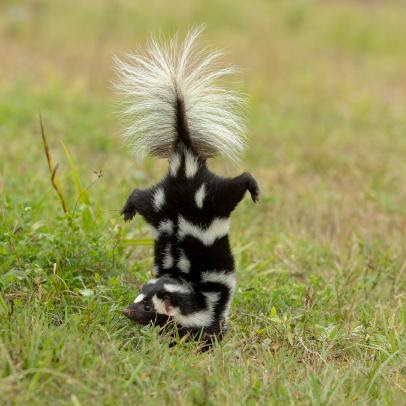
Some of us have clucked over images of baby groundhogs (“Awwwww”!), but can we resist pictures of spotted skunks?  Not only pretty, they can also do spread-eagled handstands . . .before spraying us. Now, that’s a picture!


Unlike everyday striped skunks, the spotted ones are smaller and decorated with white blots -- but they still pack “a fanny full of foul-smelling liquid” they know how to use.

It’s recently been determined that there are actually seven species of spotted skunks, half found in the east and half in the west – with some overlapping – while the seventh is native to Mexico’s Yucatan Peninsula.

One scientist who studies these “malodorous mammals” says it’s possible to sneak up on a spotted skunk and not get sprayed, while admitting that “skunks are like people. Some of them are just jerks.” 

So much for the “pet” idea.    https://tinyurl.com/22d3hsuh

Pigs don’t have a prayer           

Greeting card seen in local store with an image of browned bacon strips on the front: “I like you more than bacon.”  Then inside: “That’s the highest compliment. . .”  

Not long ago, it was a pig’s heart in a man, prompting talk of breeding pigs for that purpose, and now this bacon-obsessed mentality about love.   

Enough!

#


To comment, go to 1moreonce.blogspot.com